
What Is Demurrage? Fees, Calculation & How to Avoid It
Demurrage is the fee charged when cargo stays at a port or terminal beyond its allowed free time. Some delays are unavoidable. The expensive ones often start much earlier—with an order sitting in an inbox instead of moving into the TMS.
What is demurrage in shipping?
In container shipping, demurrage is a fee for cargo or equipment that remains inside a port or marine terminal after free time expires. It is designed to encourage cargo movement and keep terminal space available.
Free time is the allowed period before charges begin. Its length and the event that starts the clock vary by carrier, terminal, tariff, service contract, and whether the move is an import or export. Always use the terms governing the specific shipment.
Demurrage vs. detention
The terms are often grouped together, but they usually describe different parts of a container move.
Terminology is not perfectly uniform across terminals and carriers. Some providers use storage, per diem, or combined detention and demurrage language.
How demurrage charges are calculated
The simplest calculation multiplies the number of chargeable days by the applicable daily rate.
In practice, the rates usually have a tier or formula. Most commonly the first band of chargeable days may have one daily rate and later days a higher one. Weekend and holiday treatment, availability notices, holds, and appointment access can also affect the rate.
What causes demurrage?
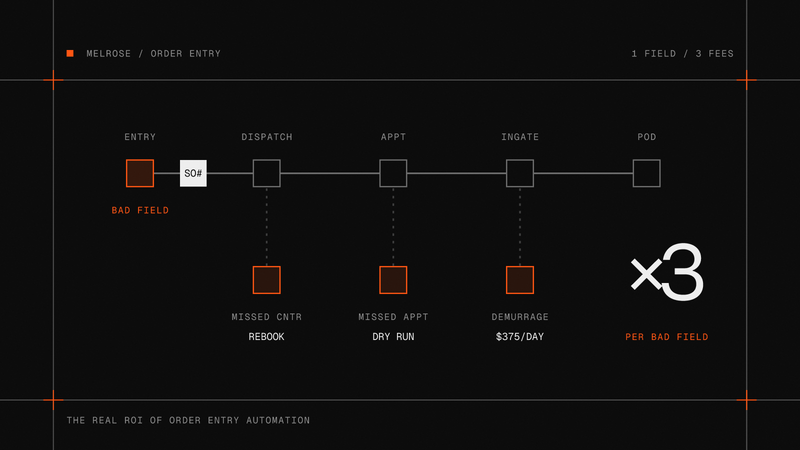
Demurrage is the last visible event in a chain of smaller delays. Orders can sit in inboxes, shipment data can be incomplete, teams can work from different systems, pickup appointments can disappear, or external holds can prevent cargo release.
Only some of these causes are within an operator’s control. A strong demurrage program separates preventable process delay from external delay, then gives the team an audit trail for both.
How to reduce demurrage charges
- 01Start the operational clock at order receipt.
Capture the order when it arrives, not when someone gets to the inbox.
- 02Create the TMS record immediately.
Dispatch cannot plan a shipment it cannot see. Remove re-keying from the handoff.
- 03Track free-time inputs in one place.
Availability, last free day, holds, releases, appointments, and container status need named owners and timestamps.
- 04Work exceptions, not every order.
Route missing or low-confidence fields to people while complete orders move automatically.
- 05Review demurrage by root cause.
Measure preventable delays separately from customs, terminal, and carrier constraints.
U.S. demurrage billing rules
For U.S. ocean shipping, the Federal Maritime Commission’s detention and demurrage billing rule requires accurate, sufficient invoice information and generally imposes a 30-day issuance deadline. In September 2025, a federal appeals court set aside the section governing who may be invoiced; the FMC states that the rest of the rule remains in effect. This guide is operational information, not legal advice.
Demurrage FAQ
What is demurrage in shipping?
Demurrage is a charge assessed when cargo or a container remains at a port or marine terminal beyond the allowed free-time period. The exact clock, rate, and exceptions depend on the carrier, terminal, tariff, and contract.
What is the difference between demurrage and detention?
Demurrage generally applies while the container is still inside the terminal. Detention generally applies after the container leaves the terminal and is not returned within the allowed free time.
How are demurrage charges calculated?
A basic calculation is chargeable days multiplied by the applicable daily rate. Many tariffs use escalating rate tiers, so later days can cost more than earlier days. Always check the governing tariff or contract.
Can automated order entry reduce demurrage?
It can reduce avoidable delays caused by orders sitting in inboxes, missing shipment records, and slow handoffs into a TMS. It cannot prevent delays outside the operator’s control, such as customs holds, terminal closures, or unavailable appointments.
Freight-ops notes, in your inbox
Product notes and playbooks on automating the manual work in logistics. No spam.