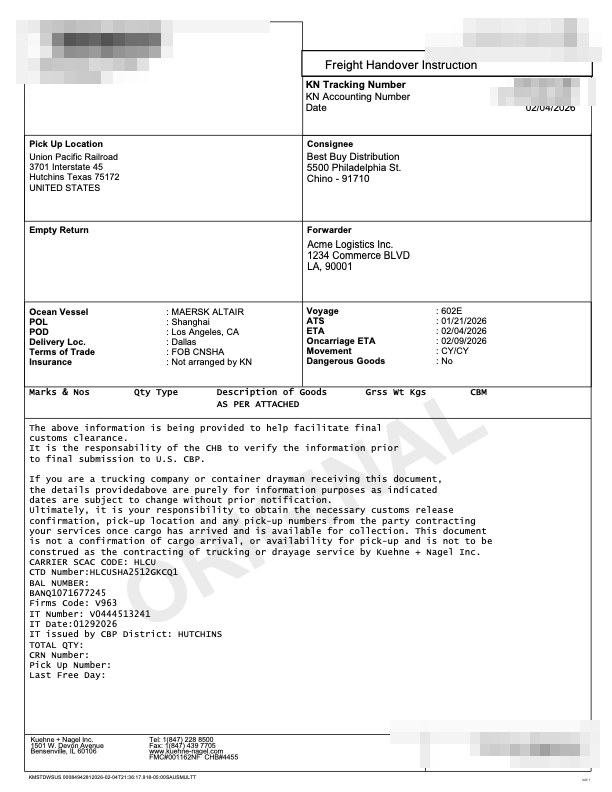


First the eyes find it, then the hands type it.
The format changes with every customer. The fields never do. Melrose learns each customer's format and writes the order into your TMS.
Trusted by teams moving real freight
Scaled volume without growing ops team
Data superpowers for every team member
20+ years of drayage expertise
Amazon Carrier of the Year The intake workbench
One queue for every incoming order, each handled by an AI that has learned that customer's format. You watch it read the order, escalate the one field it isn't sure about to the right person, and write the load into your TMS.
The problem
A delivery order takes about five minutes to key by hand. A few hundred a month adds up to whole days of typing before anyone gets to the work that actually needs a person.
A delivery order usually arrives as a PDF on an email. The information is always the same, the container, the terminal, the appointment, but the format is different for every customer. Melrose takes the repetitive entry across drayage, intermodal, FTL, LTL, and cartage, and leaves your team the exceptions.
Before / after
A person reads a delivery order field by field and keys each one by hand. That is slow, but the real cost is what slips through: a wrong container number, a skipped reference, a different judgment call on every order. Melrose reads the whole document at once, applies each customer's playbook the same way every time, and flags the one value it isn't sure about instead of guessing.
First the eyes find it, then the hands type it.
How it works
01 — Receive
Email, EDI, CSV, a portal export, or a PDF on a thread. However the order shows up, it becomes one clean order.
02 — Extract
Every field read off the document, however that customer formats it. The layout changes; the fields never do.
03 — Validate
Matched to the right shipment and checked against that customer's SOPs, the way your team would before writing it.
04 — Review
Anything it isn't sure about is flagged with the source field in view, never guessed. It would rather ask than get it wrong.
05 — Sync
Written to your TMS as a new or updated load, with a full, reviewable history of what happened.
06 — Learn
Every correction is remembered. The same customer's format never trips it up twice, and the queue gets quieter every week.
Trust
A guessed field becomes a misdelivery, and a misdelivery costs real money. Melrose writes only what it's confident about and routes anything uncertain to your team, with the source in view.
That is what earns trust: the more it proves out, the more you let it run without watching.
The payoff
Every team running Melrose has gotten FTE hours back. Hear from our customers themselves:
Beyond delivery orders
Container, booking, terminal, and appointment for every drayage move.
The load tender behind every FTL and LTL shipment, matched to the order.
Consignee, commodity, and weight reconciled against what was quoted.
Signed receipts read and filed to close the order the moment they arrive.
Delivery order automation FAQ
Straight answers on how Melrose fits your existing TMS, what it replaces, how fast it goes live, and how accurate it is.
Yes. Melrose writes finished loads straight into your existing TMS as new or updated shipments, and connects over the channels you already use, including EDI, API, email, and portals. It fits around the system your team runs today instead of replacing it, so there is nothing to rip out.
Melrose removes the repetitive typing where most errors start, then gates the rest behind confidence. Missing or low-confidence fields are routed to a review queue with the source document highlighted, so your team fixes the exception before the load is created. Every correction is remembered, so the same mistake does not repeat.
Melrose connects to the systems you already run, including your TMS, dispatch system, EDI, and accounting tools such as QuickBooks. It does not replace them. What it replaces is the manual re-keying between an inbox and a TMS, turning incoming delivery orders, rate confirmations, and bills of lading into clean records inside your existing stack.
Most teams are live in days, not months. Melrose configures around your existing TMS, document formats, and review rules, so there is no long integration project and no core system to replace. It learns each customer's format as your team works, so accuracy improves from the first week.
OCR only converts a document into text. True order entry automation reads that text, understands each field however the customer formats it, validates it against your SOPs, matches it to the right load, and writes it into your TMS. Melrose does the full job, and flags low-confidence fields for review instead of passing errors straight through.
Melrose extracts delivery order fields with about 96% accuracy, and unlike a tired operator it applies the same rules to every order. It writes only the fields it is confident about and holds the rest for a person, so errors are caught before they reach the TMS. Manual entry has no such confidence check, which is where wrong container numbers and skipped references slip through.
Book a demo and see Melrose automate a real delivery order workflow live.